

Types of Roof-Mounted Solar Panel Mounting Systems and Installation Requirements
Roof-mounted solar panel mounting systems are primarily categorised into fixed mounting systems and sloped roof fixed mounting systems based on installation methods and functional characteristics. Each type has specific installation requirements, as detailed below.
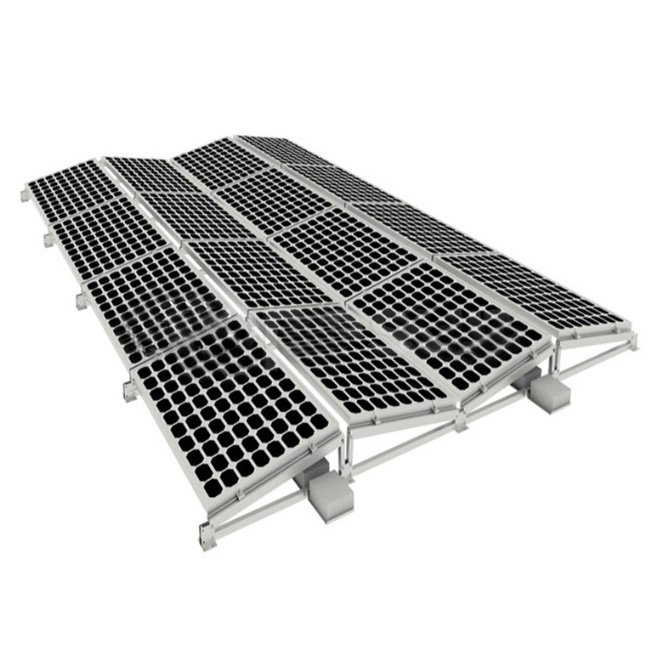
Fixed Mounting Systems
Installation angle requirements: The installation angle should be determined based on the latitude of the installation location and the optimal power generation angle of the photovoltaic panels. In the Northern Hemisphere, it is generally recommended that the installation angle be equal to the local latitude (±5°-10°) to ensure that the photovoltaic panels receive maximum solar radiation throughout the year, particularly enhancing power generation efficiency during spring and autumn seasons.
Installation spacing requirements: To avoid shadowing between rows of photovoltaic panels, the installation spacing must be reasonably determined. Spacing calculations must consider factors such as the range of solar altitude angle changes, photovoltaic panel dimensions, and installation tilt angle. These are typically determined using photovoltaic system design software or specific calculation formulas. For example, for common 60-cell monocrystalline silicon photovoltaic panels installed at a 30° tilt angle, the spacing between rows may need to reach 2–3 metres to ensure that the rear rows are not shaded after the winter solstice.
Fixed installation requirements: Photovoltaic panels are typically secured to the support beams using clamps or bolts. Clamps are often made of aluminium alloy, which offers the advantages of lightweight and high strength. During installation, ensure that the clamps securely fasten the photovoltaic panel frames to the beams. The torque of the bolts must comply with specifications to prevent the panels from loosening under external forces such as wind or snow.
Sloped roof mounting brackets
Roof-conforming requirements: The design and installation of the brackets must closely conform to the slope and shape of the roof. For example, when installing on a clay tile roof, the clamp design must consider the curvature and thickness of the tiles to ensure good contact and friction between the clamps and tiles; for colour-coated steel plate roofs, brackets can be directly fixed using self-tapping screws, but the screw length must not penetrate the roof to prevent leaks.
Load-bearing capacity considerations: The roof’s load-bearing capacity must be considered, and the weight distribution of the photovoltaic panels and brackets should be reasonably determined based on the roof structure type and materials. If the roof’s load-bearing capacity is limited, lightweight photovoltaic panels and bracket materials should be selected, or the number and density of photovoltaic panels installed should be reduced. For example, on a wooden-structured sloped roof, the weight of photovoltaic panels and brackets per square metre should not exceed 30–40 kilograms.
Waterproofing and wind resistance requirements: During installation, care must be taken to protect the roof’s waterproofing structure. Waterproofing measures must be implemented at the connection points between the mounting brackets and the roof, such as using waterproof gaskets or sealant. For wind resistance requirements, all components of the mounting brackets must be securely connected, and the photovoltaic panels must be tightly fixed to the brackets.