

Fish-Solar Synergy: A Green Dance of Water and Light, Composing a New Chapter in Rural Revitalisation
As the first rays of morning sunlight glisten on the rippling surface of the fish pond, the neatly arranged solar panels on the water begin to eagerly absorb solar energy, converting it into a steady stream of clean electricity. Beneath the solar panels, fish and shrimp thrive in the water. This is ‘fish-solar synergy’—an innovative model that seamlessly integrates aquaculture with photovoltaic power generation. It not only achieves the dual benefits of ‘power generation above and fish farming below’ but also paints a harmonious picture of ecological beauty, thriving industries, and prosperous communities across the vast water-rich landscapes.
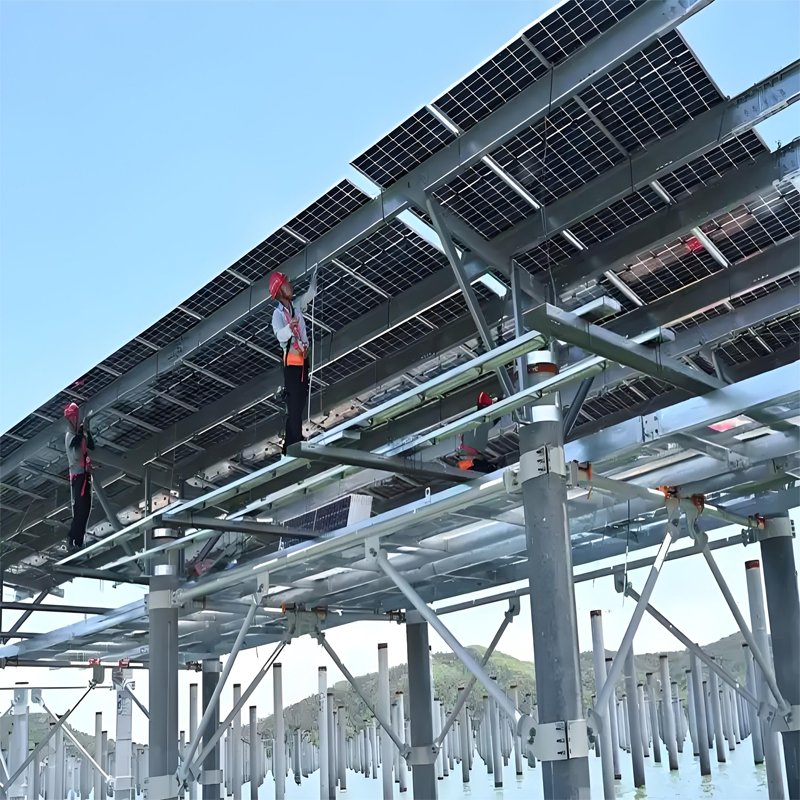
Fish-Solar Synergy: The Perfect Fusion of Multiple Benefits
The charm of the fish-solar synergy model lies in its unique ‘dual-use’ characteristic, like a wise magician, it brings vibrant dual value to the same body of water.
An Economic Multiplier: It does not occupy valuable agricultural, industrial, or residential land, significantly increasing the economic value per unit area of land. The upper layer of photovoltaic panels generates stable income through electricity production, while the lower layer of fish ponds cultivates fish and shrimp to create additional wealth, forming a three-dimensional economic model of ‘power generation above and fish farming below.’ This has brought significant economic growth to the local area and ensured farmers’ land appreciation benefits. For example, in some projects, the underwater fish farming project can generate substantial income for the village collective annually, which can be used as special funds for rural revitalisation, achieving ‘double income growth’ for both villagers and the collective.
Guardian of environmental benefits: As a clean energy source, photovoltaic power generation does not emit greenhouse gases during the power generation process, effectively reducing environmental pollution caused by traditional energy power generation and achieving significant energy-saving and emission-reduction benefits. Additionally, photovoltaic panels can block sunlight, lower water surface temperatures, reduce water evaporation, and inhibit algae growth, providing a more suitable environment for aquaculture and achieving a positive interaction between ecological protection and energy production.
Contributor to social benefits: The promotion of photovoltaic-fishery complementary projects has provided new employment opportunities for the local area and promoted the optimisation and upgrading of the rural industrial structure. It integrates the concept of green development into rural construction, injecting new vitality into rural revitalisation. It represents an innovation and breakthrough in traditional rural development models, demonstrating how to perfectly combine the beauty of the countryside with modern innovation.
Key Conditions for the Development of Fishery-Photovoltaic Complementary Projects
The successful implementation of fishery-photovoltaic complementary projects is not accidental; it requires specific natural conditions and socio-economic foundations as support.
Suitable Natural Conditions: Regions with a high population density, limited land availability, but extensive water areas are conducive to installing more solar photovoltaic panels, fully utilising the vast water surface resources. Additionally, the region must have abundant solar radiation to ensure the efficiency and stability of photovoltaic power generation.
Strong energy demand: Regions with conventional energy shortages and high electricity demand have a more urgent need for new energy sources. The electricity produced by fish-solar hybrid projects can effectively alleviate local energy pressures.
Sound economic and technological foundations: Economically developed regions with ample funds and advanced technology have the capacity to bear the initial investment and subsequent operational maintenance costs, providing a solid foundation for the smooth implementation of fish-solar hybrid projects.
Fish-solar hybrid: A model for the future integration of agriculture and energy
As an innovative model combining energy and agriculture, the fish-solar hybrid model’s synergistic effect of ‘1+1>2’ is increasingly evident. It not only provides new approaches to addressing energy shortages and environmental issues but also opens new pathways for sustainable agricultural development. The successful implementation in Yangnaotou Village, Xiangfu Town, and other areas vividly demonstrates that fishery-solar hybrid projects can achieve a win-win outcome in terms of ecological, economic, and social benefits, serving as an excellent example of the mutually reinforcing relationship between green development and economic growth. With ongoing technological advancements and policy support, fishery-solar hybrid projects will undoubtedly play an increasingly important role in future rural revitalisation and energy transition efforts, illuminating the green future of rural areas.
Translated with DeepL.com (free version)