

Here’s the English translation:
In-Depth Analysis and Selection Guide for Core Components of Seismic Bracing Systems
As a critical safety installation in modern building mechanical and electrical (M&E) engineering, the performance of a seismic bracing system depends directly on the quality and compatibility of its individual components. This article provides a comprehensive analysis of the key components of seismic bracing systems, covering material characteristics, mechanical properties, and installation considerations, with the aim of offering professional guidance for engineering design and construction personnel.
Seismic Bracing System Overview and Working Principle
A seismic bracing system is a specialized seismic-resistant structure designed to bear the loads of mechanical and electrical pipelines, air ducts, cable trays, and similar installations within buildings, thereby mitigating damage to non-structural components during earthquakes. With their unique mechanical design and high-quality component integration, these bracing systems effectively absorb and dissipate seismic energy, preventing piping systems from detaching or fracturing, and ensuring the continuous safe operation of a building’s internal M&E systems.
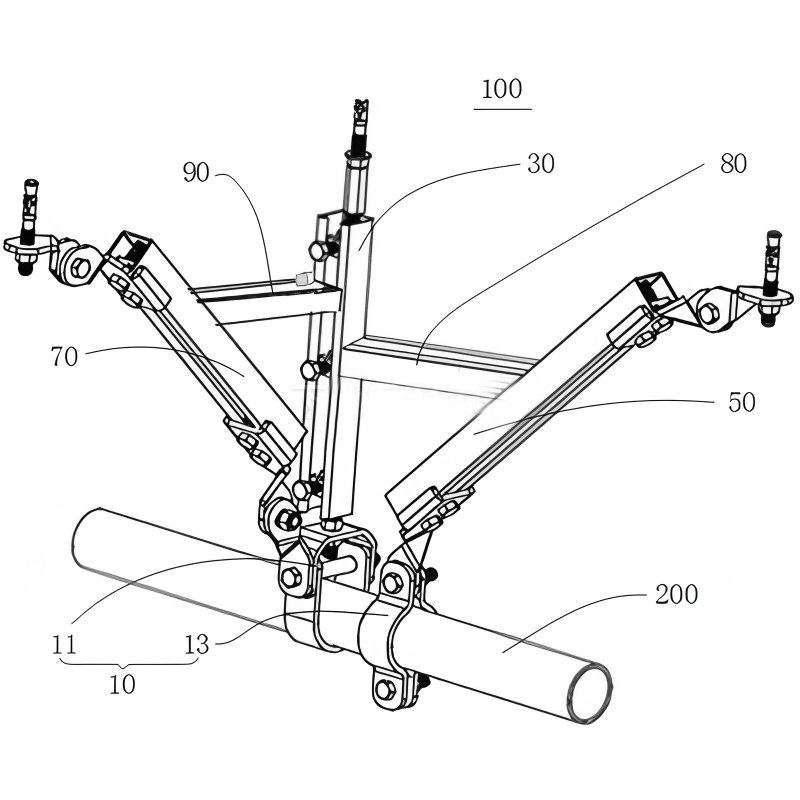
Modern seismic bracing systems are typically composed of seismic braces, reinforced cantilever beams, anchors, connectors, and pipe clamps, forming a complete load-bearing framework. The system must satisfy the fundamental seismic requirements: “No damage under minor earthquakes, repairable under moderate earthquakes, and resistant to collapse under major earthquakes.” Its performance directly affects the continuity of a building’s critical lifelines and the safe evacuation of personnel during seismic events.
In accordance with the Code for Seismic Design of Mechanical and Electrical Equipment in Buildings (GB 50981-2014), seismic bracing must be capable of withstanding horizontal seismic forces, with its seismic design intensity matching that of the main structure. This requires every component to undergo precise calculation and rigorous component selection, ensuring that the entire system operates in a coordinated manner under seismic loading.
Detailed Analysis of Core Seismic Bracing Components
Channel Steel and Related Components
Channel steel is the primary load-bearing member in a seismic bracing system, and its performance directly influences the overall load-carrying capacity of the bracing structure. Currently, mainstream products include:
Hot-Dip Galvanized Channel Steel: Manufactured from Q235B carbon structural steel through hot rolling and hot-dip galvanizing processes, with a zinc coating thickness of ≥ 80 μm, offering excellent corrosion resistance. Standard lengths are typically 3 meters or 6 meters, with flange thicknesses ranging from 1.5 mm to 3.0 mm. Common flange heights are 41 mm, 52 mm, and 62 mm.
Stainless Steel Channel Steel: Made from 304 or 316 stainless steel, providing superior corrosion resistance. It is particularly suitable for highly corrosive environments such as chemical plants or coastal areas. However, the cost is relatively high, approximately 3 to 5 times that of galvanized channel steel.
Aluminum Alloy Channel Steel: Lightweight and corrosion-resistant, but with relatively lower load-bearing capacity. It is primarily used for special applications where weight sensitivity is a concern.
Channel Steel Accessory Assemblies include:
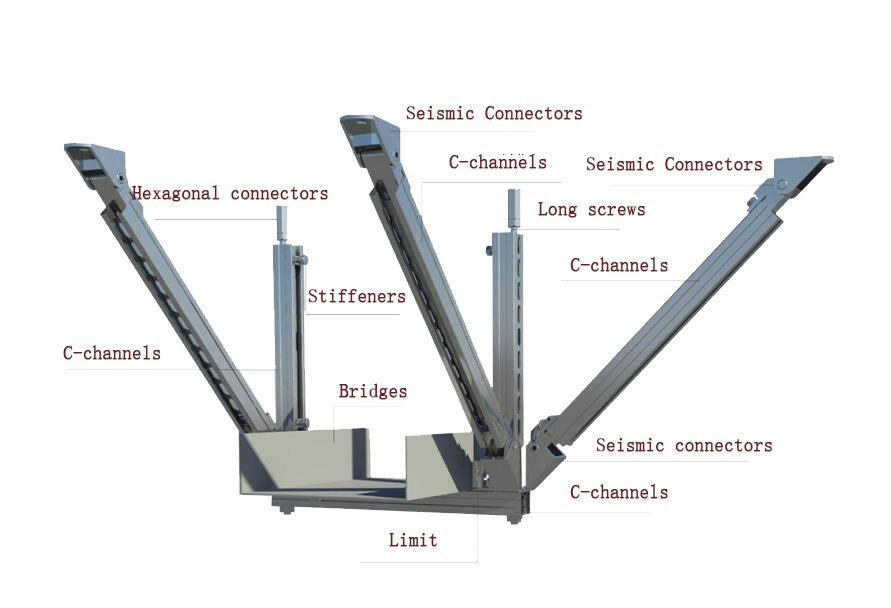
Channel Steel Locking Clamps: Used for perpendicular connections between channel steel profiles, manufactured from high-strength steel to ensure joint rigidity.
Channel Steel End Caps: Installed at the ends of channel steel to prevent end-face corrosion and enhance aesthetic appearance.
Channel Steel Extension Plates: Used for horizontal extension connections, typically requiring connection strength no less than that of the channel steel itself.
Seismic Hinges and Swivel Joints
Seismic hinges are critical movable components in seismic bracing systems, allowing pipes to displace within a specified range to absorb seismic energy:
Unidirectional Seismic Hinges: Allow rotation in a single plane only, suitable for seismic bracing of straight pipe sections, typically accommodating a rotation angle of ±30°.
Universal Seismic Hinges: Enable free multi-directional rotation, suitable for seismic bracing of complex piping systems, with rotation angles generally in the range of ±15° to ±30°.
Seismic Hinges with Locking Mechanisms: Remain in a fixed state during normal operation and automatically release the rotation function during an earthquake, combining everyday stability with seismic performance.
High-quality seismic hinges should possess the following characteristics:
- Body Material: Ductile cast iron or stainless steel
- Rotating Components: Self-lubricating bearings or bronze bushings
- Surface Treatment: Hot-dip galvanizing or Dacromet coating
- Static Load Capacity: ≥ 5 kN; Dynamic Fatigue Life: ≥ 5,000 cycles
Seismic Pipe Clamps and Clamping Devices
Seismic pipe clamps are key components for securing pipes to seismic bracing, designed to balance retention strength and seismic resilience:
Universal Pipe Clamps:
- Suitable for securing pipes of various diameters
- Rubber-lined interior protects the pipe and enhances friction
- Adjustable design for easy installation
Specialized Clamps:
- Designed for specific pipe materials (e.g., PVC, copper)
- Accommodate thermal expansion and contraction characteristics
- Special shapes prevent stress concentration on pipes
Anti-Slip Clamps:
- Feature pipe restraint mechanisms
- Prevent longitudinal pipe displacement during earthquakes
- Typically form an integrated load-bearing system with the seismic bracing
Key Material Selection Criteria for Clamps:
- Metal Components: Hot-dip galvanized steel, stainless steel, or aluminum alloy
- Lining Materials: Neoprene, silicone rubber, or EPDM
- Fasteners: High-strength bolts, minimum Grade 8.8
Seismic Anchors and Suspension Rod Systems
Anchors are critical connection components that secure seismic bracing to the building structure. Their performance directly affects the reliability of the entire seismic system: